30-Day Guide to Transformation Programme Recovery
My Transformation Programme Has Stalled: How Do I Get It Back on Track?

If your transformation programme has stalled, deadlines are slipping or delivery no longer feels under control, you are not alone. Most large programmes reach a point where decisions slow down, teams start working to different assumptions or the original plan no longer matches reality.
It is a difficult phase, not a failure. But if a stalled programme is left unresolved, planned benefits are delayed or never realised, costs keep building and confidence across the business starts to drop. What starts as project delay can quickly turn into commercial pressure, stakeholder disengagement and delivery fatigue.
This page explains why programmes lose momentum, what recovery actually looks like and gives you some practical steps to focus on in the first 30 days to get a stalled transformation programme moving again.
Why transformation programmes stall
A stalled transformation programme is usually the result of issues building over time; in decisions, ownership and delivery clarity.
- The original plan no longer matches reality.
The programme is still being managed against a plan that no longer reflects reality. New priorities have appeared, timelines have slipped and assumptions made six months ago are still driving decisions. When the plan is not reset, teams keep working to dates and assumptions that no longer hold. Over time, this leads to value erosion. The programme continues, but the outcomes start to drift and the business case becomes harder to justify. - Decisions are taking too long or happening in the wrong place.
As priorities change, issues are escalated to larger groups or more senior stakeholders, while delivery teams are waiting for answers. The same issues come back into meetings week after week, small delays become missed milestones and people start working around the problem instead of solving it. As decisions slow, delivery stalls but costs do not. The programme continues to consume budget and resource without making proportional progress. - Accountability has become blurred.
Ownership has become fragmented as the programme has grown. Everyone seems busy, but when something slips nobody can say who is responsible for fixing it. Teams assume someone else owns the issue, suppliers wait for direction and the next milestone quietly moves further away. This often accelerates loss of stakeholder confidence, as it becomes unclear who owns delivery and where decisions are actually being made. - The team is solving symptoms, not the real blocker.
Pressure often creates activity rather than progress. The response to delay is often another meeting, another status report or another recovery plan. Everyone is working harder, but the same blocker is still there next week. If the root cause is unclear, effort increases while momentum continues to drop. Work continues, but it becomes fragmented, with teams focusing on local activity rather than the end-to-end outcome. - Confidence has started to break down.
As reality and reporting drift further apart, people stop believing the dates in the plan. Sponsors ask for more updates, teams become cautious about making commitments, and every meeting becomes a discussion about why things are late rather than what needs to happen next. The programme then spends more energy explaining delays than making progress. As this continues, teams become fatigued and disengaged, and the programme risks losing key people and delivery capability altogether.
The longer these patterns continue, the more it damages the team’s ability to deliver. This shows up commercially (value and cost), structurally (alignment and governance), and culturally (confidence and morale). Once those start moving together, the programme becomes much harder to recover.
What a recovered transformation programme looks like
A recovered transformation programme is not risk-free, but it’s no longer stalled or drifting. The priorities are clear, the plan reflects what is actually happening and people know what needs to move next.
Decisions are made in the right place, quickly enough for teams to keep going. Ownership is clear, so issues do not sit between teams or wait for someone to pick them up. Progress is visible week by week, including what has been completed, what is still at risk and where senior leaders need to step in.
Teams spend less time explaining why things are late and more time doing the work that moves the programme forward. The programme feels controlled again because people can see what matters, what is changing and what needs attention.
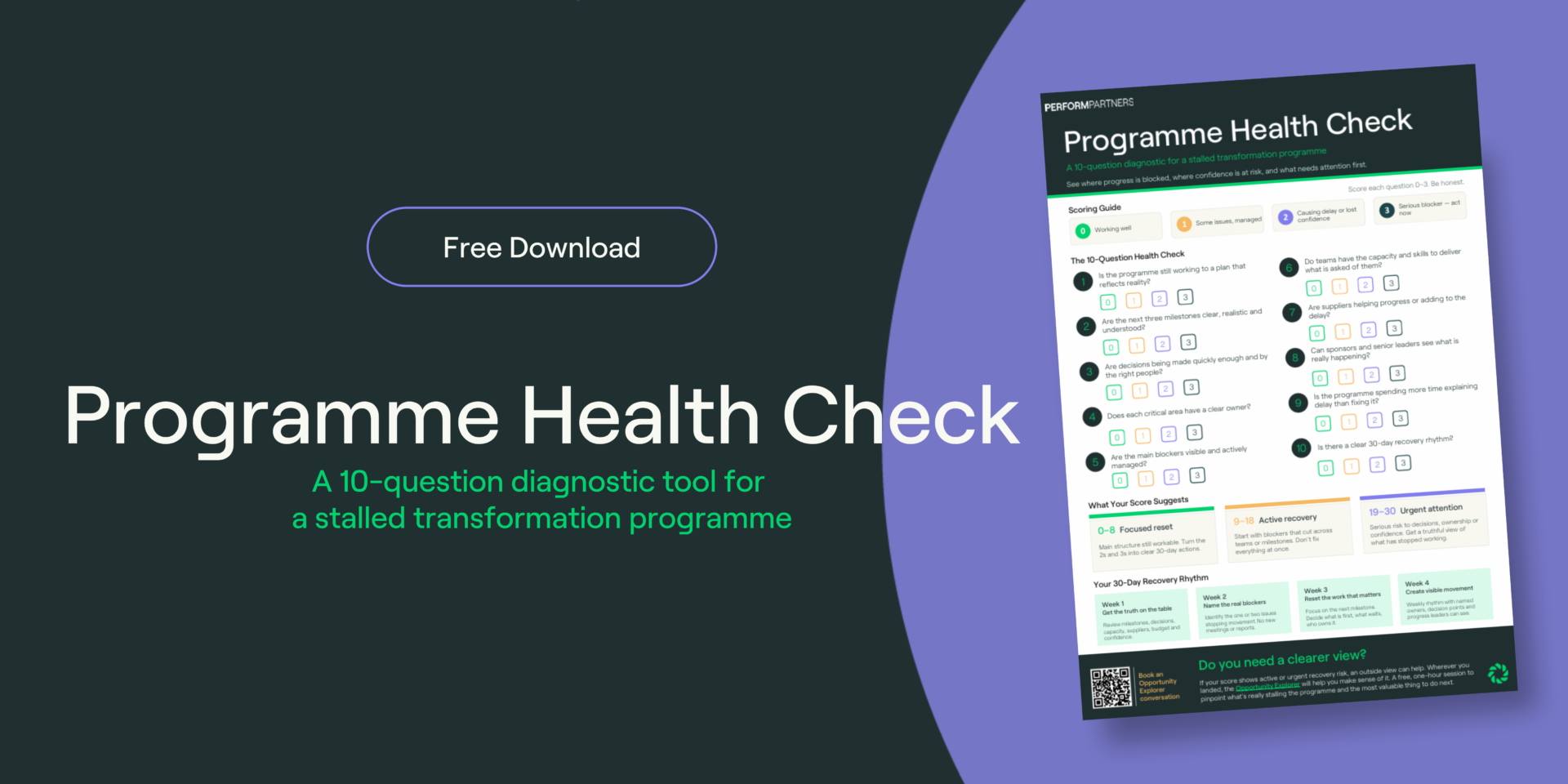
A 30-day practical guide to getting a stalled transformation programme back on track
Days 1–5: Establish what is actually happening (replace assumptions with facts)
What to do:
Rebuild a factual view of the transformation programme as it actually is, removing any ambiguity.
Focus areas:
- What milestones are consistently being missed or slipping (and why)
- Where decisions are repeatedly escalated or delayed
- Where work is blocked across multiple streams and teams
- Where confidence in delivery has broken down (explicitly, not assumed)
It’s often at this point that the real picture starts to shift. In this financial services programme, stepping back to review delivery progress, stakeholder expectations and the original business case quickly made it clear where timelines and reality had drifted apart: 18 months in, the programme was facing delays, budget pressure and falling short of its original objectives, despite the level of effort already invested. From there, the programme was able to reset its direction against what was actually achievable and reset expectations across stakeholders.
Key output:
A clear view of the current programme state and the key points of breakdown.
Days 6–12: Identify the real constraints (not the symptoms)
What to do:
Once the real state is visible, move from surface issues to identifying what is actually constraining progress.
Typical root constraints are:
- Unclear decision ownership
- Misaligned sequencing of delivery work (teams working in the wrong order)
- Capacity or capability gaps in key roles
- Too many parallel priorities
- A plan that no longer reflects the business context
Key output:
A clear and prioritised set of core constraints that explain why the programme has lost momentum.
Days 13–20: Re-establish a workable delivery path
What to do:
With constraints understood, simplify the programme back to what actually drives progress.
This involves:
- Focus only on the work that affects near-term delivery outcomes
- Force closure on decisions that are blocking multiple workstreams
- Pause or remove activity that no longer supports recovery
- Re-sequence delivery to remove structural friction
- Assign named owners to every critical dependency
At this point, usually progress starts to return. On one large-scale cloud transformation, momentum only picked up again once the work was broken into phases, dependencies were re-sequenced and teams focused on what could actually move next.
Key output:
A simplified, credible delivery path to the next key milestone. The aim is to restore forward motion in a stalled transformation programme, not to rebuild the full plan.
Days 21–26: Restore visible momentum through a fixed recovery rhythm
What to do:
At this stage, shift the recovery approach of the stalled transformation programme to consistency rather than complexity.
Establish a stable weekly cadence by:
- Setting a fixed agenda at the same time each week
- Surfacing blockers early and consistently
- Ensuring decisions are owned and time-bound
- Making progress visible to stakeholders again
This is often where confidence starts to return. Introducing a consistent reporting rhythm and clearer ownership in this governance recovery programme made it much easier to surface blockers early and keep decisions moving. A clear reporting rhythm was established through defined ownership, decision logs and structured governance across teams and suppliers, with escalation routes and risk tracking put in place, so issues could be picked up early and dealt with before they slowed things down.
Key output:
A stable recovery cadence with clear decision flow and escalation routes.
Days 27–30: Stabilise control and reset for the next phase
What to do:
Once momentum has returned, the focus shifts to preventing the transformation programme from stalling again.
Actions:
- Confirm decision rights and ownership
- Align stakeholders on what success now looks like
- Validate the simplified delivery path against capacity and reality
- Ensure ownership sits with delivery teams, not just programme oversight
Key output:
A stabilised delivery model for the next phase of work.
Where external support can make a real difference to a stalled transformation programme
External help is most effective when:
- Decision-making is structurally or politically stuck
- Internal teams are too close to reset the plan objectively
- Capability or capacity gaps are slowing recovery
The role of external support is not to replace the programme team. It is there to help restore clarity, accelerate decisions and stabilise delivery so control can return more quickly, with any deeper involvement only happening where it’s genuinely needed.
In many cases, this can start with a short, informal conversation, a chance to talk through what’s happening openly, without commitment and work out the right next steps before anything more structured is put in place.

FAQ
How do I get a stalled transformation programme back on track?
Start by getting a clear view of what has actually stopped moving. Look at missed milestones, decisions that haven’t been made, critical dependencies, team capacity, supplier delivery and stakeholder confidence. Then separate symptoms from causes. A recovery plan should focus on the few things blocking progress across the programme, not on rewriting the same plan again.
Why has my transformation programme stalled?
Most transformation programmes stall because the plan no longer matches what is really happening on the ground. Priorities change, decisions slow down, dependencies are harder than expected, or teams do not have the capacity to deliver at the pace required. The issue is often not effort. It is that the programme is still being run against assumptions that are no longer true.
What should I do first if my transformation programme is behind schedule?
Start with the critical path, not the full plan. Identify the milestones that matter most, the decisions needed to reach them and the dependencies blocking progress. Then check whether each area of work has clear ownership and enough capacity to deliver. This gives you a practical view of what needs to change now, instead of getting pulled into every overdue task.
When should we bring in outside help for a stalled programme?
Bring in outside help when the pressure is clear, but the programme is not moving. This usually shows up when teams are stretched, decisions are unclear or slow, and confidence has started to drop. The right support should help clarify what is blocking progress, bring structure back to the programme and get things moving again without replacing the people already involved.
How long does it take to recover a stalled transformation programme?
Recovery starts with clarity, not a full replan. In the beginning, the focus is on understanding what is blocking progress, resetting the critical path, agreeing the decisions needed and putting a simple delivery rhythm in place. Confidence does not come from solving everything at once. It comes from seeing progress on the things that matter most.

Need help understanding what’s blocking progress?
Opportunity Explorer (Free for a Limited Time)
A 1-hour conversation designed to help organisations understand their situation, identify the key issues and determine the most appropriate next step.
Book an Opportunity Explorer →
Opportunity Accelerator
A structured workshop designed to develop the requirements, roadmap and plan needed to move forward.