Product
Opportunity Explorer:
Senior-Led Transformation Advisory
A one-hour, senior-led transformation advisory session that helps you pressure-test a business, change, technology or transformation decision before committing budget or resource.
Not every opportunity should become a programme, project or investment.
Growth, technology, operations, transformation and regulatory change all compete for attention, funding and leadership time. Some opportunities are worth backing. Others need more evidence, a different route or a clear stop.
Before you commit budget, people or executive sponsorship, you need confidence that the opportunity is worth pursuing, the assumptions stand up and the likely outcome justifies the investment.
Opportunity Explorer gives you one focused hour with a senior advisor to pressure-test that decision. We bring an independent perspective and practical experience across business change, technology, operations and transformation to challenge assumptions, surface the risks and identify what still needs answering.
You leave with a clearer view of the opportunity, the credible options, the evidence gaps and the next decision to make.

Why Organisations Use The Opportunity Explorer
There are points where an opportunity looks credible, but the case for backing it is not yet strong enough.
Several options may be competing for the same budget. Different stakeholders may see the answer differently. An initiative may have lost momentum, or a recommendation may be heading towards a board or investment committee with assumptions that have not yet been challenged.
Opportunity Explorer creates room to test that thinking before more is put behind it. The answer may be to continue with greater confidence, investigate one question further, change direction or decide that the opportunity does not currently justify the investment.
That is the value of doing the thinking early.
What Is The Opportunity Explorer?
Opportunity Explorer is a one-hour working session with a senior advisor.
You bring the opportunity and the context you already have. We work through what you are trying to achieve, the thinking behind the current options and the assumptions that are carrying the most weight in the decision.
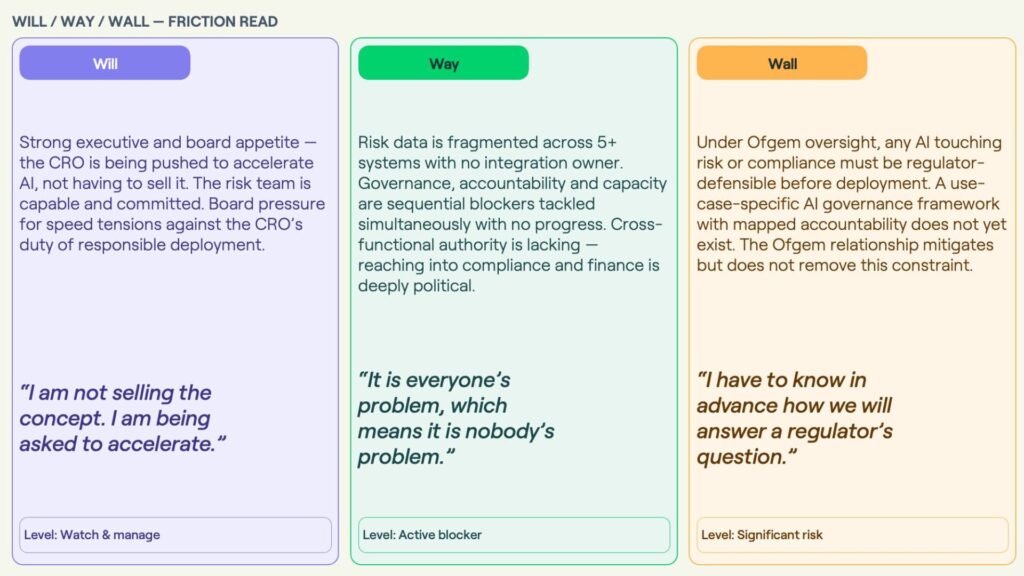
The conversation is structured using the ACLIG Friction Diagnostic across Will, Wall and Way:
- Alignment (Will): Are the people who matter aligned on the outcome and priority?
- Capacity (Will): Is there enough ownership, capability and organisational capacity to take it further?
- Literacy (Wall): Do the people involved understand the opportunity and its implications well enough to make the decision?
- Infrastructure (Wall): Are technology, data, process or operating constraints likely to affect the route being considered?
- Governance (Way): Are decision rights, controls and oversight appropriate for the level of risk involved?
ACLIG is there to make sure important questions are not missed. It is not a detailed assessment of the future programme, nor does the session attempt to design the answer.
The purpose is simpler: establish what you know, what you are assuming and what still needs to be understood before deciding whether the opportunity deserves further attention.
What kinds of opportunities can you explore?
The subject can be broad. Opportunity Explorer is not tied to a particular technology, department or type of change.
Examples include, but are not limited to:
- AI opportunities: pressure-testing where AI may create value, which opportunities deserve further investigation and what assumptions or constraints need validating
- Cloud opportunities: weighing cloud strategy, migration, modernisation, cost, control or platform choices before deciding whether deeper assessment is justified
- Operating model decisions: testing whether the proposed direction makes sense and where ownership, governance, capability or organisational questions remain unresolved
- Regulatory and compliance priorities: clarifying the decision, relevant constraints, evidence gaps and areas requiring further investigation
- Data and insight opportunities: exploring where better use of data, reporting, analytics or insight could support a business outcome
- Business and transformation strategy: pressure-testing priorities, investment choices, transformation decisions or competing strategic routes
- Operational improvement: exploring process, service, customer, cost, productivity or capability opportunities
- Programme and project direction: examining a stalled, high-risk or high-value initiative before committing further resource
- Technology and modernisation decisions: comparing potential directions, constraints and assumptions around technology, architecture or legacy environments
These are examples, not limits.
Opportunity Explorer does not attempt to fully assess or design each of these areas in one hour. Its purpose is to establish whether the opportunity is worth pursuing, what remains uncertain and which decision should come next.
What Happens During The Session?
There is nothing to prepare in advance. You do not need a presentation, business case, requirements document or supporting pack. This is a conversation.
Bring the opportunity, the options already being discussed and the information you have. If people disagree on the direction, an assumption is doing a lot of work, or there is a question nobody has been able to answer yet, that is useful context too.
The conversation then goes where the decision needs it to go. For one organisation, that may mean spending more time on ownership and stakeholder alignment. For another, the important question may sit around data, governance, capability or a technology constraint.
ACLIG gives us a consistent way to challenge the opportunity without forcing every conversation through the same script.
We are not there to turn an hour into detailed discovery. We are there to help you separate what is known from what still needs proving, so the next decision is based on something stronger than assumption.
What Does An Opportunity Explorer Look Like?
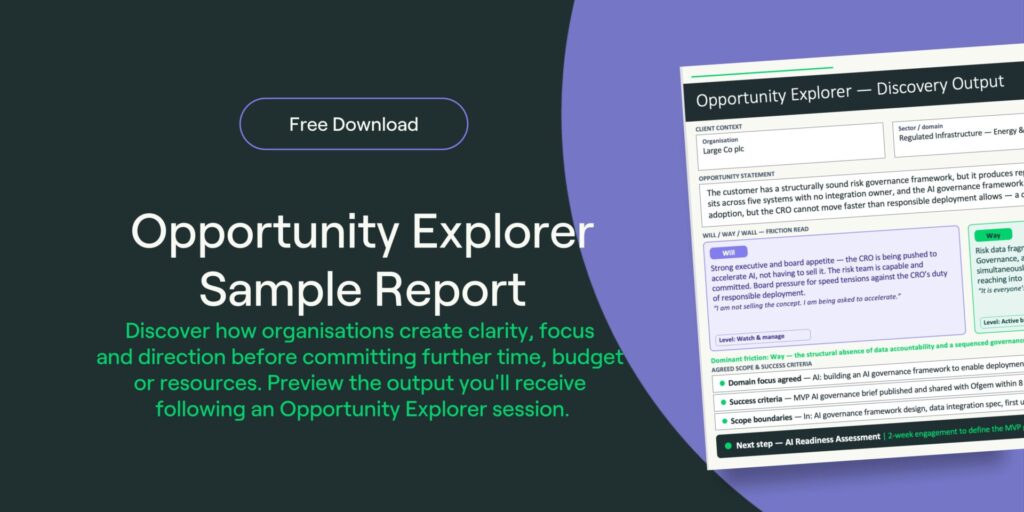
It begins with an Opportunity Statement. This puts the issue into plain language: what is being considered, what outcome matters, why a decision is needed now and what is at stake if the organisation acts or does not act. That gives everyone the same starting point.
The output then captures the credible choices discussed during the session, the assumptions behind them and the questions where more evidence could materially affect the decision. ACLIG is used to show where organisational friction may need further attention, without turning the Explorer into a detailed delivery assessment.
What matters most is the conclusion. The output sets out which decision should come next and why. That may mean proceeding with the direction already under consideration. It may mean testing one assumption, obtaining more evidence or looking at one area in greater depth. In some cases, the sensible decision will be to pause or stop.
If another piece of work is justified, the Explorer identifies what deserves further investigation, not how that work should be delivered. That distinction matters. Opportunity Explorer stops at the point where you know what question needs answering next. It does not define requirements, produce a delivery plan or create an implementation roadmap.
Data Protection and Confidentiality
We only ask for the information needed to understand the opportunity and produce the output.
Information shared during the session is treated as confidential. Non-disclosure agreements are available before the session where required, deliverables are transmitted securely, and session notes are retained only for the period needed to produce the written output.
What Happens Next?
There is no automatic progression from an Opportunity Explorer into another Perform Partners engagement.
You may have enough information to decide and continue with your own team. The Explorer may identify a question that needs specialist assessment, or show that the opportunity should wait until a dependency or evidence gap has been resolved. It can also conclude that further investment is not justified at this point.
Where another piece of work would be useful, we will explain what needs investigating and why.
Indicative routes can include:
- Opportunity Accelerator
- A deeper AI Assessment
- A Cloud Viability Assessment
- Operating model assessment*
- Regulatory and Compliance support
- Data and Insight work*
- Business and Technical Architecture
- Business-case development*
- Client-led delivery using the findings*
- No further activity until a dependency or evidence gap is resolved*
For more information about any of the routes marked with an asterisk, please contact Perform Partners using the form below.
If an opportunity has been established and the organisation now needs to define requirements, delivery risks, friction and a practical roadmap towards delivery, that is a different product: Opportunity Accelerator.
Opportunity Explorer determines what deserves further investigation and which decision should come next.
Opportunity Accelerator takes an identified opportunity and works out what is required to move it towards delivery.
Keeping those two jobs separate is deliberate. There is no obligation to continue with Perform Partners, and we will not turn an Explorer into a larger piece of work simply because one is available.
Delivered by senior specialists with experience across regulated industries, the public sector and enterprise technology.
Perform Partners has a 4.8/5 client satisfaction score.
Have An Opportunity You Need To Test?
If there is an opportunity on the table but you are not ready to back it, bring us what you have.
One focused hour can give you a stronger basis for deciding whether to take it further, investigate something specific or stop before more is committed.

Start the conversation
Commonly Asked Questions About The Opportunity Explorer
What is an Opportunity Explorer?
It is a one-hour, senior-led transformation advisory session that helps leaders pressure-test a business, change, technology or transformation decision before committing significant budget or resource.
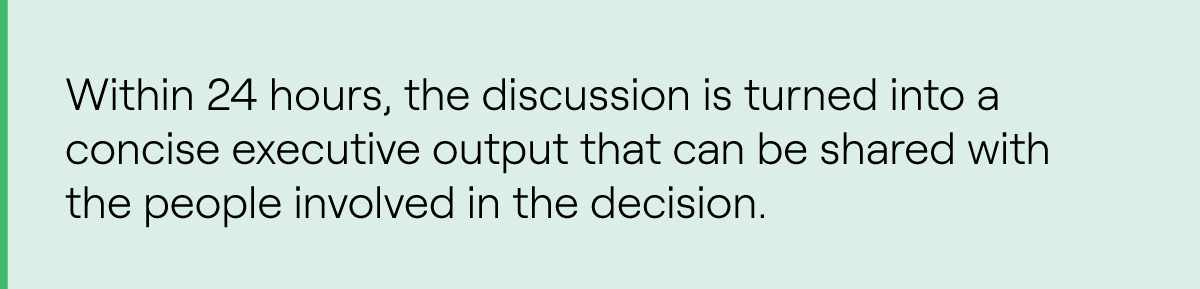
It creates a structured view of the decision, options, assumptions, friction and evidence gaps, followed by a concise output within 24 hours.
What kinds of decisions can Opportunity Explorer help with?
The session supports strategic, operational, business, change and technology decisions.
Examples include AI opportunities, cloud strategy, operating model choices, data and insight, regulatory and compliance change, operational improvement, modernisation, programme direction and wider business transformation priorities.
The list is not fixed. The relevant question is whether there is an important decision, competing options or unresolved uncertainty that needs senior challenge before commitment.
What is the difference between Opportunity Explorer and Opportunity Accelerator?
Opportunity Explorer creates clarity before commitment. It helps establish what the opportunity is, which options are credible, what remains uncertain and which decision should come next.
Opportunity Accelerator starts with an opportunity that has already been identified and takes it further into requirements, delivery risks, friction and a practical route towards mobilisation.
Explorer helps you decide whether and where to go further. Accelerator helps define how an identified opportunity can move towards delivery.
What does the Opportunity Explorer output include?
The output can include:
- An opportunity statement
- Decision context
- Options and trade-offs
- ACLIG friction findings
- Key assumptions and evidence gaps
- Risks and constraints
- Decision criteria
- The recommended next decision
- Indicative next steps
It deliberately stops short of detailed requirements, solution design, project planning or an implementation roadmap.
Does Opportunity Explorer produce a roadmap?
Not an implementation roadmap.
The Explorer may indicate the broad next area to investigate, but it does not define detailed activities, requirements, sequencing, resources or delivery plans.
Where an identified opportunity needs that level of definition, Opportunity Accelerator or another specialist assessment may be the appropriate next step.
How does the ACLIG Friction Diagnostic influence the output?
ACLIG examines Alignment, Capacity, Literacy, Infrastructure and Governance.
It helps identify where friction could enable, slow or block progress. These findings inform the decision criteria, evidence gaps and questions that should be addressed before further commitment.
Can Opportunity Explorer help us explore an AI opportunity?
Yes.
Where AI is the decision in front of you, Opportunity Explorer can help determine whether the opportunity warrants further investment or a deeper AI opportunity assessment.
The session can challenge assumptions around the opportunity, surface questions around readiness or governance and identify what evidence is missing.
It is not a substitute for the full AI Assessment, which provides deeper assessment and prioritisation.
Can Opportunity Explorer help assess a cloud opportunity or cloud strategy?
Yes.
It can help pressure-test a cloud decision, including questions around migration, modernisation, cost, architecture, control or operating capability.
The Explorer identifies the questions and evidence that matter to the decision. It does not perform the deeper environment analysis provided through a Cloud Viability Assessment.
Can it support an operating model assessment or organisational change?
Yes.
Opportunity Explorer can help examine an operating model direction, organisational change or capability decision.
The ACLIG Friction Diagnostic can expose questions around alignment, capacity, literacy, infrastructure, governance and ownership that should be addressed before a model is developed in greater detail.
Can it be used for regulatory, compliance, data or operational priorities?
Yes. Opportunity Explorer is not limited to technology.
It can be used to pressure-test regulatory and compliance decisions, data and insight opportunities, process or service improvement, cost and productivity questions, programme direction and other material business changes.
Can it help with wider business strategy or investment decisions?
Yes, where there is a specific decision or opportunity to test.
It can help leaders examine competing priorities, assumptions, risks, evidence and decision criteria before committing further investment.
It does not replace corporate strategy development, financial due diligence or a detailed business case.
What should I bring to the session?
Bring the decision or opportunity you want to test, the outcome you are aiming for and enough context to explain the current position.
Existing options, assumptions, constraints, deadlines or areas of disagreement are useful where available.
You do not need a completed business case or detailed solution pack.
Do I need a completed business case before the session?
No.
Opportunity Explorer is intended to happen before that level of detail is necessarily available.
Enough context to explain the decision, desired outcome, known options and constraints is sufficient.
Is Opportunity Explorer a workshop or scoping exercise?
No.
It is a focused senior advisory conversation built around a specific decision. It does not produce detailed requirements, solution designs, project plans, delivery scope or an implementation roadmap.
How is confidential information handled?
Information shared during the session and within the deliverable is treated as confidential.
Non-disclosure agreements are available on request before the session. Deliverables are transmitted securely, and session notes are retained only for the time needed to produce the written output.
What happens after Opportunity Explorer?
The answer depends on what the Explorer finds.
You may proceed using your own team, gather additional evidence, undertake a specialist assessment, move into Opportunity Accelerator, pause the initiative or decide not to progress it.
There is no obligation to continue with Perform Partners.