AI Adoption: Practical Guide for Leaders
Why AI Adoption Fails, Even When the Technology Works

Why AI Adoption Fails, Even When the Technology Works
Your organisation has invested in AI. Tools are available, pilots are active and teams have been encouraged to use them. Yet working practices have changed very little, the value remains difficult to prove and further investment is becoming harder to justify.
Understanding why AI adoption fails requires a close look at the work surrounding the technology.
AI adoption fails when the organisation introduces new capability without addressing the conditions required for people to use it well. The technology may be working exactly as designed. The surrounding process, ownership, data, controls and measures prevent it from becoming part of dependable day-to-day work.
This creates activity without enough operational progress.
Why AI adoption fails despite growing investment
AI can spread quickly across an organisation without creating consistent value.
People may use it to draft emails, summarise documents or explore ideas. Individual teams may run promising pilots. These activities can be useful, but they do not show that AI has improved an important business process or created an outcome that can be measured.
Research published by the Department for Science, Innovation and Technology in February 2026 examined 3,500 UK businesses. Just over half of the organisations already using AI felt ready to scale their use. The research also found that 77% had not yet seen a change in revenue following adoption.
These findings show the gap leaders need to address. Access and regular usage can grow before the organisation is ready to turn AI into sustained business value.
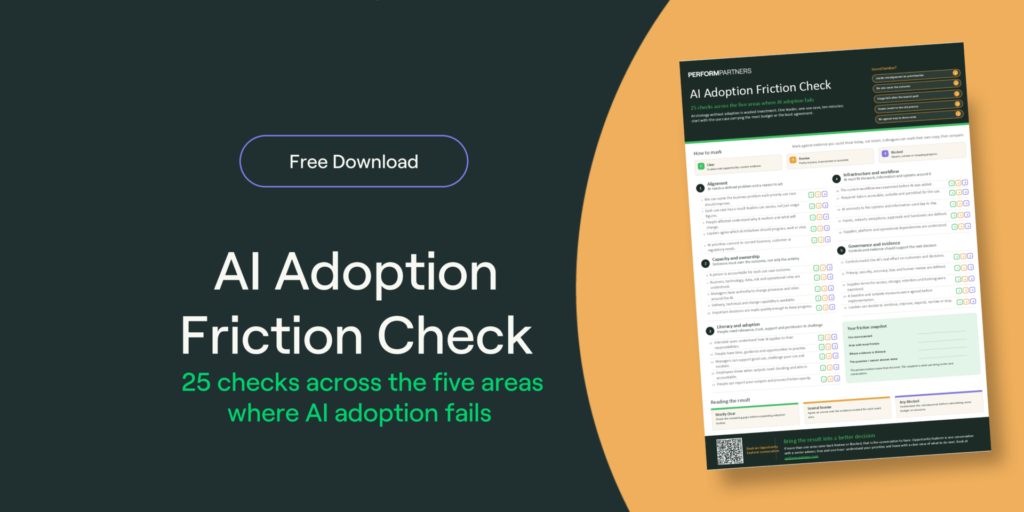
Seven reasons AI adoption fails
1. The purpose is too broad
An instruction to use AI more does not give teams a business problem to solve.
Objectives such as improving productivity or becoming an AI-enabled organisation sound positive, but they offer little practical direction. Different teams interpret them in different ways. Activity spreads across small, disconnected uses and leadership cannot see which ones deserve further attention.
A stronger starting point identifies:
- the process or decision that needs to improve;
- the people who will use the capability;
- the expected operational or commercial effect;
- the evidence required before further investment.
The use case needs enough detail for a team to design, test and measure it.
2. The existing workflow has not been redesigned
AI is often added to the way work already happens.
The output may still need to be copied between systems. Existing approval stages remain in place. Employees repeat the original task to check the answer. A time saving in one activity can create additional checking, administration and uncertainty elsewhere.
The workflow needs to show where AI contributes, what information it uses and what happens to the output. It must also define the points where professional judgement, approval or escalation remain necessary.
Without this work, AI becomes another tool for employees to manage alongside the process they already had.
3. Nobody owns the complete outcome
AI adoption crosses business leadership, technology, data, operations, security, risk, legal, HR and change teams.
Each function may own an important part of the work. Problems arise when responsibility for the complete outcome sits between them.
The business may own the ambition while technology manages access. Risk teams may be asked to approve a use case after key design decisions have been made. Managers may be expected to increase usage without the authority to change the process.
The initiative needs a named outcome owner, agreed decision rights and a practical route for resolving issues. Governance meetings can support that ownership, but they cannot replace it.
4. Employees cannot see how AI improves their work
Generic demonstrations can introduce the technology. Adoption depends on whether people can apply it to their day-to-day responsibilities.
Employees need relevant examples, suitable guidance and time to practise. They also need straight answers about accuracy, confidentiality, customer impact and the effect on their role.
Low adoption can point to several practical concerns:
- the use case adds little value;
- the output is difficult to trust;
- using the tool creates more work;
- expectations are unclear;
- employees believe they will be blamed for poor results;
- managers give conflicting signals about acceptable use.
Training has a role, but it cannot correct a weak use case or an unsuitable workflow.
5. Data, integration and governance are addressed too late
Early pilots often use selected information and limited access. Operational use introduces more complex conditions.
Data may be incomplete, duplicated or held across several systems. The tool may not connect to the applications where work happens. Supplier terms may restrict how organisational, employee or customer information can be processed.
The organisation needs to decide:
- which information the AI system can use;
- whether a supplier may retain that information or use it for model training;
- who can access inputs, outputs and activity records;
- how accuracy, bias and poor outputs will be identified;
- where human review and approval are required;
- how incidents, exceptions and changes will be managed.
Human review means a person checks, approves or can change an AI-supported output before it affects a customer, employee, service user or important business decision.
These decisions belong in the use-case design. Leaving them until final approval creates delay and can force the team to revisit completed work.
6. Too many pilots compete for limited attention
A successful demonstration can create pressure to launch more experiments, extend access or purchase additional licences.
Leadership attention, specialist capability and adoption support are then spread across a growing list of initiatives. Strong use cases compete with weaker ideas, and none receives enough ownership to become dependable.
The organisation should understand why a pilot worked before expanding it. Leaders need evidence of the outcome, the conditions that made it possible and the support required to operate it at a larger scale.
The next decision may be to scale the use case. It may also be to improve it, narrow its scope or stop investing in it.
7. Measurement stops at access and usage
Licence activation, logins, prompts and training attendance provide useful management information. They do not prove that AI has improved the work.
Useful adoption measures connect three areas.
Use: Are the intended people applying AI within the agreed workflow?
Quality and control: Do the outputs meet the required standard, and are exceptions being handled properly?
Business outcome: Has the process improved against the measure that justified the investment?
For example, a customer service use case may need to measure handling time, resolution quality, escalation rates and customer outcomes. Prompt volume would add very little to that decision.
What poor AI adoption costs the organisation
Unused licences are only one part of the cost.
Employees may create informal workarounds because approved tools do not meet the need. Teams can develop conflicting practices and duplicate effort. Managers spend more time checking outputs, while employees become less willing to discuss mistakes or experiment openly.
The investment case also becomes harder to manage. Leadership may struggle to distinguish a technology limitation from a problem with how the initiative was designed. Useful work can be cancelled alongside weaker use cases, or further budget can be committed without evidence that the underlying conditions have improved.

How to reset an AI adoption programme
- Establish what is happening in practice
Build an accurate view of the tools, pilots and informal uses already present across the organisation.Identify who is using them, which workflows they affect, what information is involved and where employees have created alternative approaches. Compare the expected benefits with the experience of the people doing the work.Include the parts that have not worked. They often reveal more about the barriers to adoption than a successful demonstration. - Select one outcome worth improving
Choose an operational problem with a named owner and a realistic route to evidence.The first reset does not need to solve AI adoption across the organisation. It needs to show that one worthwhile use case can become part of normal work without creating unacceptable risk or hidden effort. - Redesign the workflow
Map the current process and define the role AI will play.Show how information enters the process, what the user does with the output, where judgement remains essential and how exceptions are handled. Remove duplicated checks where the evidence supports doing so. - Agree ownership and controls
Define responsibility for the business outcome, day-to-day operation, technology, data and risk decisions.Controls should reflect the consequences of the use case. An internal drafting tool requires a different level of oversight from a system supporting decisions about customers, employees or service users. - Support people in the working environment
Use examples taken from real roles and processes. Give managers enough knowledge to support employees, challenge poor use and escalate concerns.Create a simple way for users to report unreliable outputs, process friction and new opportunities. That feedback should inform the next version of the use case. - Make an evidence-based decision
Set the baseline before changing the workflow. Measure use, quality, exceptions, effort and the intended business result.The evidence should support a specific decision: continue, improve, expand, narrow or stop.
When external support can help
Some adoption problems can be corrected by the existing team. External support becomes useful when the cause crosses several functions, specialist capacity is constrained or leaders need an independent assessment before committing further investment.
Perform Partners helps organisations:
- understand why AI activity is not producing the expected outcome;
- assess readiness across people, process, data, technology and governance;
- identify which use cases deserve further investment;
- define ownership, decisions, controls and measures;
- redesign the route from AI activity into operational use;
- provide practical delivery and change capability where it is needed.
The work can begin with a focused decision session or progress into delivery support. The appropriate scope depends on the use case, the barriers identified and the capability already available within the organisation.
Responsible AI adoption in practice
Perform Partners supported Basingstoke College of Technology with an AI-enabled marking assistant designed to reduce pressure on teachers while preserving assessment quality and professional judgement. Teachers helped define the requirements, test the outputs and refine the system. Student work was anonymised before processing and final assessment decisions remained with teachers.
Pressure-test your AI adoption challenge
Further investment should follow a clear view of the problem, the evidence and the decision that needs to be made.
Opportunity Explorer for AI, Data and Governance provides a one-hour working session with a senior adviser. It helps organisations examine an opportunity, test its important assumptions and identify what still needs to be understood before further budget or resources are committed.

Frequently Asked Questions About Why AI Adoption Fails
Why does AI adoption fail?
Adoption can fail when a tool is introduced without a specific outcome, workable process, accountable owner, suitable data, proportionate controls or practical support for the people expected to use it. Access can create activity, but sustained adoption depends on whether AI becomes a useful and trusted part of real work.
Is employee resistance the main cause of poor AI adoption?
Employee concerns can indicate that the purpose, process or expectations need attention. People may question an AI tool because its output is unreliable, its use creates more work or the effect on their role has not been explained. Investigate these conditions before deciding that attitude is the problem.
Can more training improve AI adoption?
Training helps people develop the skills required for a sound use case. It will have limited effect when ownership is unclear, data is unreliable, the technology is unsuitable or the workflow gains little from AI.
How should leaders measure AI adoption?
Measure whether the intended users apply AI in the agreed workflow, whether outputs meet the required quality and control standards, and whether the process has improved against the outcome that justified the investment.
Should a successful AI pilot be scaled?
Scale a pilot when the organisation understands why it worked and whether those conditions can be maintained. Review its business case, user behaviour, data, integration, security, human oversight, operating ownership and support requirements before expanding it.
What happens if AI is not the right answer?
Redirect or stop the work. The assessment may show that the underlying problem sits in the process, data or operating model and can be resolved more effectively without AI.