Perform Partners Secures G-Cloud 15 Place, Continuing Public Sector Technology and Transformation Work


Perform Partners has secured its place on the UK Government’s G-Cloud 15 framework, continuing a relationship that began with G-Cloud 12 in 2020 and providing public-sector organisations with an established route to access our cloud, technology and change expertise.
For public-sector organisations, G-Cloud provides an established procurement route for accessing approved cloud services and suppliers. Our continued place on the framework gives organisations across government, local authorities, healthcare and education another recognised way to engage Perform Partners.
The timing feels particularly relevant.
Modernisation pressures across the public sector
Across the public sector, organisations are balancing the need to modernise with the realities of maintaining critical services, working within constrained budgets and making the best use of already stretched teams.
Some are addressing ageing infrastructure that has served them well but now needs a longer-term direction. Others are exploring where AI could make a meaningful difference to services, productivity or employee wellbeing. Alongside these sit security, resilience, operational improvement and growing expectations around digital services.
The opportunity is considerable, but so is the responsibility to make the right decisions.
Many significant technology programmes represent decisions an organisation will make infrequently. Internal teams bring deep knowledge of their services, people and operating environment, but may have limited reason to maintain specialist capability for a particular migration, modernisation or emerging technology initiative between those moments.
It means the early questions matter. What does the organisation actually need? What should happen first? What are the dependencies? Where would investment create the greatest value? And what level of external support would genuinely help?
Those questions have shaped much of our work across the public sector.
Supporting public-sector technology transformation at different scales
At the University of Sheffield, the starting point was a significant infrastructure challenge.
Perform Partners worked alongside the University’s internal team as it modernised its core student record system on AWS, bringing cloud design, engineering, technical expertise and change management support to the programme. The transformation enabled TUOS to realise value through a 15x improvement in process performance and strengthened stability and disaster recovery readiness, while 50–60 members of the University’s IT team were upskilled during delivery.
Knowledge transfer formed part of the approach. As internal capability developed, our involvement reduced, helping the University build the knowledge and confidence to carry its modernisation forward.
Elsewhere in higher education, the right starting point has been earlier in the decision-making process. An organisation can know that its infrastructure needs attention without yet having enough evidence to determine the right destination, level of investment or sequence of change.
Experienced support at that stage can help teams understand the environment, assess the available routes and build confidence in a decision before significant resources are committed.
The appropriate response can also be much smaller.
Responsible AI adoption in further education
At Basingstoke College of Technology (BCoT), the opportunity for technology started with a very human challenge.
Teachers were regularly giving up evenings and weekends to marking, and the College wanted to explore whether AI could reduce that pressure while maintaining assessment quality and keeping professional judgement with teaching staff.
Working with BCoT, AWS and Ingram Micro, Perform Partners supported the development of Fixter, a teacher-led AI assessment tool. The initiative was accelerated by securing $25,000 in AWS credits through the AWS One Government Value Agreement (OGVA), helping create room for BCoT to explore AI without placing the same pressure on an already constrained budget.
Fixter reviews student work, drafts feedback and supports quality checks, while teachers retain control to edit, challenge and finalise the outcome. Teachers using it have reclaimed up to five hours per week, demonstrating how thoughtful adoption of emerging technology can support staff wellbeing alongside organisational efficiency.
BCoT set the pedagogical direction while Perform Partners helped translate those requirements into the technical approach, with security, data protection, ethical safeguards and teacher feedback considered as part of the delivery.
Public-sector change does not always need to take the form of a large transformation programme, either.
At Barnsley Metropolitan Borough Council, our work focused on operational change within social care management. The engagement helped a defined part of a much larger organisation bring greater structure to its priorities and ways of working, including the development of an actionable roadmap for its highest-priority change requirements.
The scale of these engagements varies considerably. That matters.
A major university transformation and a further education college exploring a targeted application of AI require very different levels of support. A specific operational challenge within one local authority team is different again.
Experience should help an organisation find an appropriate route through its challenge, shaped around the capability, resources and priorities it already has.
“What our work across the public sector has reinforced is that every organisation starts from somewhere different. The pressures may be familiar, but the environment, available capacity, budget and outcome they need are their own.
Our client relationships are built around understanding that first. We can support a significant transformation programme when that is what’s required, but equally there are times when a small amount of experienced support around the right problem can make the difference. G-Cloud gives public-sector organisations a straightforward route to bring that experience in when they need it.”
Shaun Walsh, Co-founder and Director at Perform Partners
Making public-sector change sustainable
There is another consideration that becomes particularly important when budgets, time and specialist skills are finite: what remains when external support steps away.
The strongest engagements build on the knowledge already inside an organisation. Outside expertise should complement the people who understand its services, users, constraints and operating environment every day.
That is particularly important where specialist capability is needed for a period of change but does not need to become a permanent overhead once that change has been delivered.
“The people inside an organisation understand their environment better than anybody coming into it, so good delivery has to start there. We bring experience of complex change, but we apply that alongside the knowledge and capability the client already has.
Operationally, that means being able to adjust the shape of our support as the work develops. We can bring specialist capability in when it’s needed, work alongside internal teams and reduce our involvement as knowledge and confidence grow. The objective is to help the organisation make progress in a way it can sustain once our part is complete.”
David Rush, Head of Business Strategy & Operations at Perform Partners
Finding the right place to start with technology modernisation
Modernisation does not always arrive as a single, neatly defined programme.
A legacy platform may need attention at the same time as an emerging AI opportunity. Security and resilience can compete with operational improvements for the same budget and people. Several initiatives may have credible cases for investment, while organisational capacity means they cannot all move at once.
Having greater clarity at that point can help leadership understand the choices before significant resources and investment are committed.
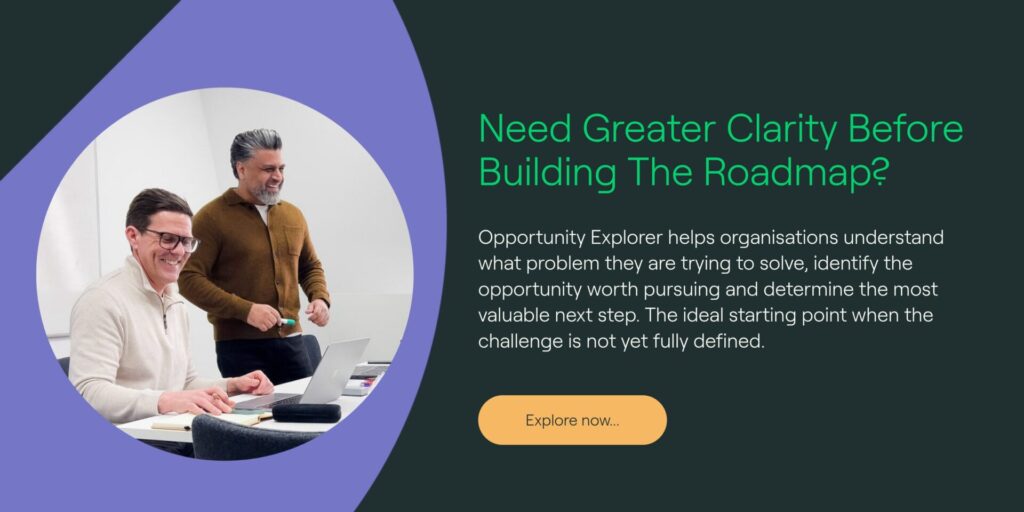
That thinking underpins Opportunity Explorer.
It provides a focused, senior-led conversation for organisations that want to pressure-test a business, technology, change or transformation decision before committing significant budget or resource.
The conversation brings together the opportunity, available evidence, constraints, dependencies and assumptions already shaping the decision. From there, the aim is to understand the credible routes forward, identify where further evidence may be needed and establish a practical next decision.
There is no product demonstration, system access or data upload, and no onward commitment to Perform Partners.
For public-sector organisations balancing modernisation with budget, capacity and competing priorities, sometimes greater clarity on what deserves attention first is the most useful place to begin.